
Please note that the content on these pages is updated frequently to reflect ongoing changes. The final revision of the game rules is anticipated for Fall 2026.
Learn to Play
Everything you need to know to run a Resilience by Design workshop
You can review all the components of the game below.
Or you can begin by reading the guidebook.
When you are ready to play, you can download all components here.
All components are licensed under a CC BY 4.0 licence.
Get Started
Tips for Success
- Build toward bigger projects: As you complete Level 1 projects and collect permanent bonuses, you’ll unlock the ability to afford Level 2 and Level 3 projects—and eventually achieve your Community Resilience Goals.
- Communicate openly: Share your role’s particular strengths with the team. Each role has unique abilities that can benefit everyone.
- Remember you can trade (once your mat flips to Side 2): Trading tokens between players once per turn, by mutual agreement, can help complete projects faster.
- Just start somewhere: The game only lasts an hour, so don’t overthink your first moves. Jump in!
- Select hazards and create community resilience goals that are priorities for your community or region.
Game Overview
Resilience by Design is a serious game focused on climate change planning, adaptation, mitigation, and resilience. It blends gameplay with learning to build shared understanding while practicing collaboration, communication, and planning under pressure.
The Workshop Structure
- Pre-game Workshop: Choose hazards, co-create community resilience goals, and establish a shared points target.
- 1-Hour Play Session: A timed cooperative session simulating one fiscal year.
- Facilitated Discussion: Review which goals were achieved and what could change.
- Planning Activity: Work with achieved goals using the Community Resilience Planning Canvas.
- Debrief: Discuss how to apply lessons learned to real-world contexts.
Game Objective
Work together to reach or exceed the community target (points) within 1 hour. The base target is 56 points. Each hazard selected adds to this target.
Winning & Losing
This is a collaborative game—you win or lose together as a team! If the team total meets or beats the shared target when time expires, the community succeeds. If not, discuss what could be improved and consider the optional 15-minute extension.
Why Reserve Cards?
Reserving a project card is a strategic action with two key benefits:
- Secure a project for yourself: When you reserve a card (face-up or blind from the deck), it goes to your Reserved Projects area. No other player can complete it—it’s yours alone to finish on a future turn.
- Gain Wild Aid: Reserving is the only way to gain Wild Aid tokens! Each time you reserve, you take 1 Wild Aid from the bank (if available). Wild Aid can substitute for any resource type when completing projects.
Reserve strategically when you see a valuable project you can’t afford yet, or when you need Wild Aid to complete something else. Remember: most roles can hold up to 3 reserved projects (Local Government and Local Authority can hold 4).
Game Contents
Resource Tokens
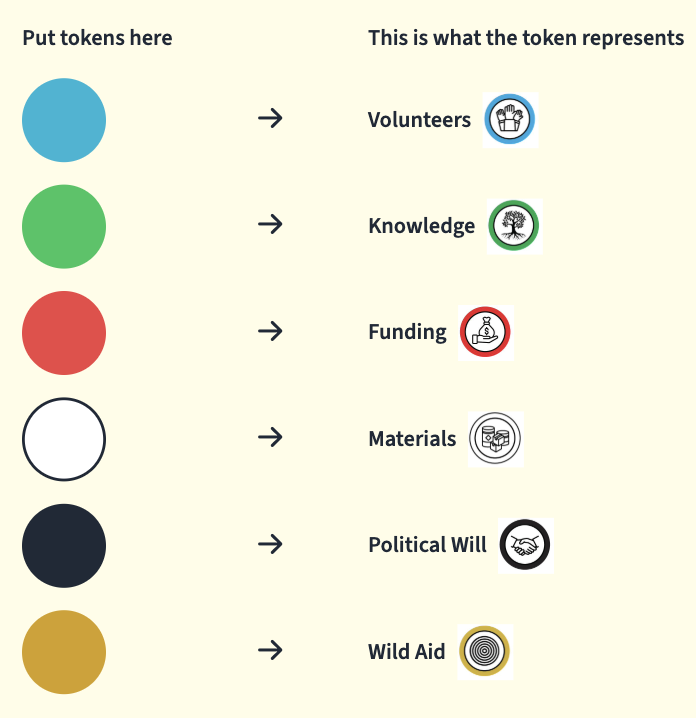
Colour-coded tokens representing 6 categories of resources:
Volunteers
Community members contributing time and effort
Knowledge
Expertise, research, and information sharing
Funding
Financial resources and grants
Materials
Physical supplies and equipment
Political Will
Government support and policy backing

Wild Aid
Flexible resources that can substitute for any other type
Begin with 7 of each standard color and 5 Wild Aid in the resource bank.
Project Cards (130 total)
The game structures projects into three progressing tiers:
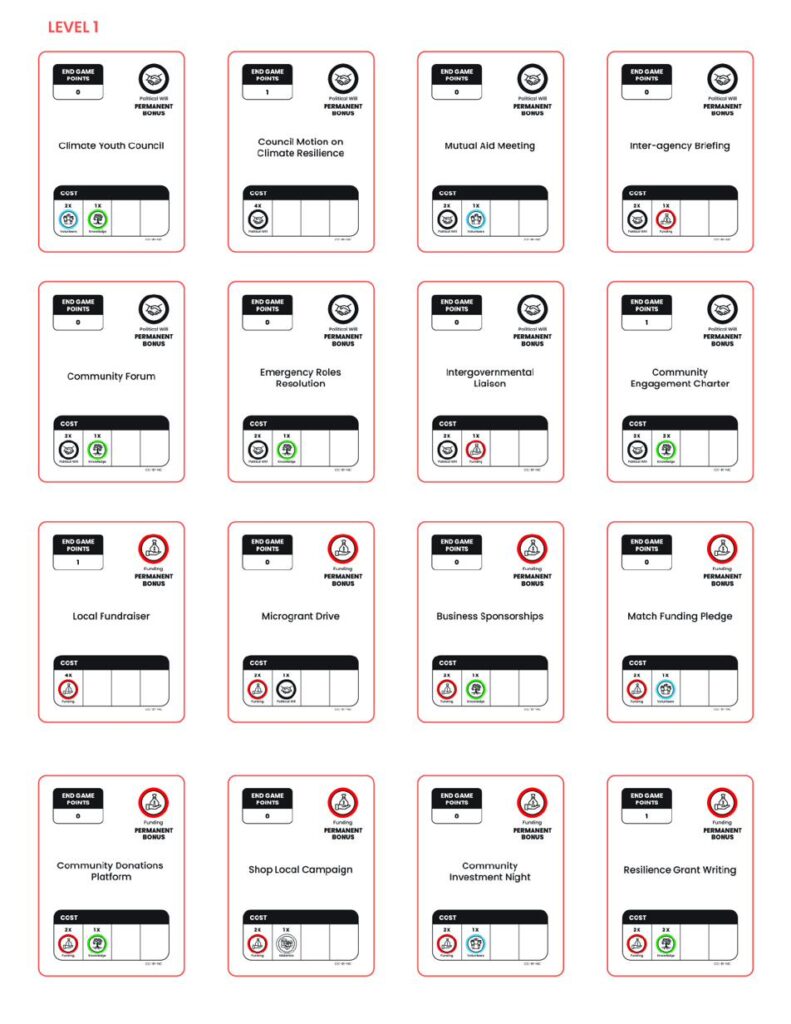
- Level 1 — Local Capacity (40 cards): Low-cost, foundational actions like creating volunteer networks or conducting risk assessments. 1–3 resources, 0–1 points, 1 permanent bonus. Emphasis on capacity building.
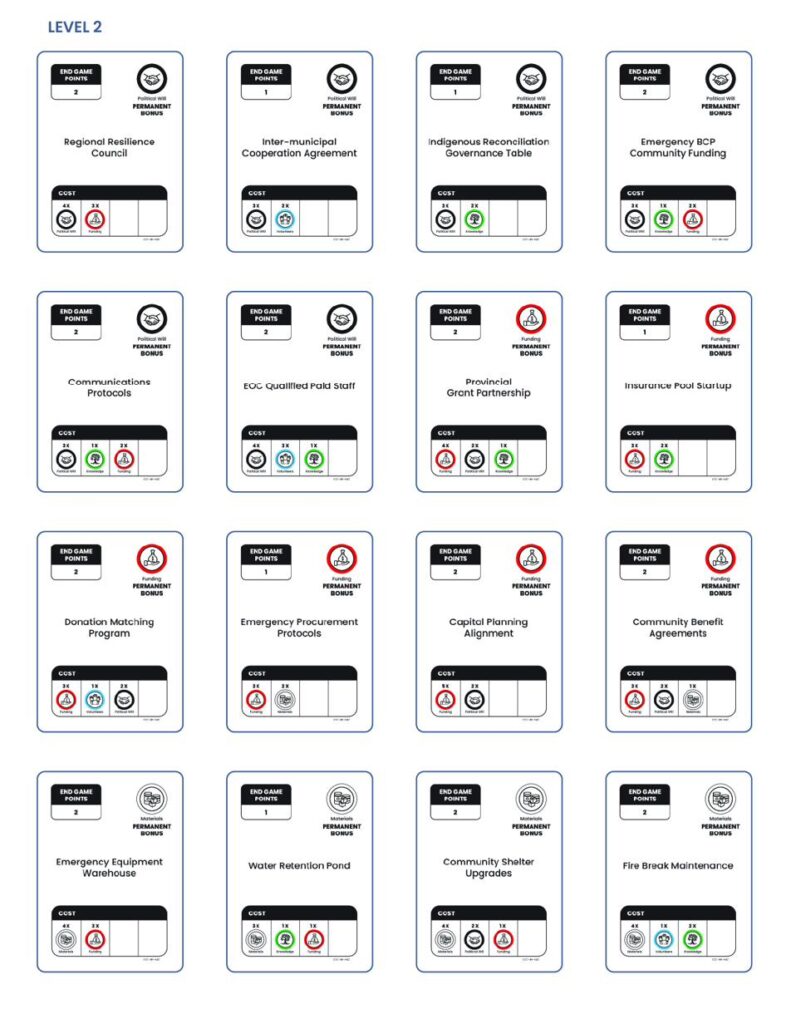
- Level 2 — Scaling Capacity (30 cards): Medium-cost, coordinated multi-sector initiatives. 3–5 resources, 1–2 points, 1–2 permanent bonuses. Balanced mix.
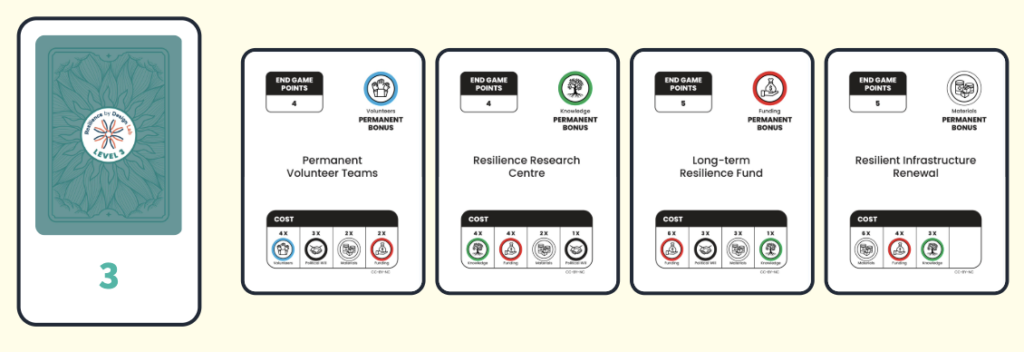
- Level 3 — Resilient Systems (60 cards, 5 hazard decks): High-cost, high-impact infrastructure and policy frameworks. 8–9 resources across 3 types, 3–4 points, 1 permanent bonus. Hazard-specific decks of 12 cards each: Extreme Heat & Heat Waves, Wildfire & Smoke, Riverine & Urban Flooding, Coastal Flooding & Storm Surge, and Multi-Hazard & Cascading Events. During setup, pick 2 decks matching the hazards chosen in the pre-game workshop for a total of 24 cards in play.
Understanding Project Cards
Each project card has three key elements:
- End Game Points (top left): Points you earn when the game ends. Add all points from completed projects to your score.
- Permanent Bonuses (right side): Resource icons you can use to complete goals or other projects. These bonuses stay active once the project is completed.
- Cost (bottom): Resources needed to complete the project. Pay these tokens to the bank when completing the project.
Scoring Reminder
In the Player Scores table: Enter the total point value from all completed project cards of each level, not the number of cards. For example, if you completed four Level 1 projects with one project worth 0 and three others worth 1 point each, enter “3” in the Level 1 Projects column.
Other Components
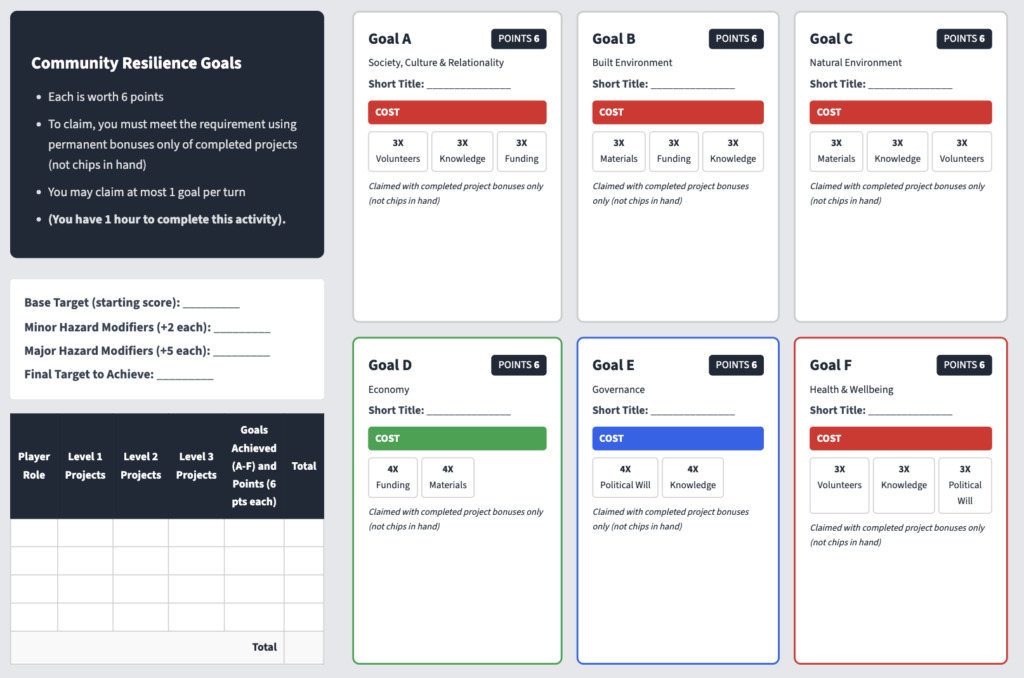
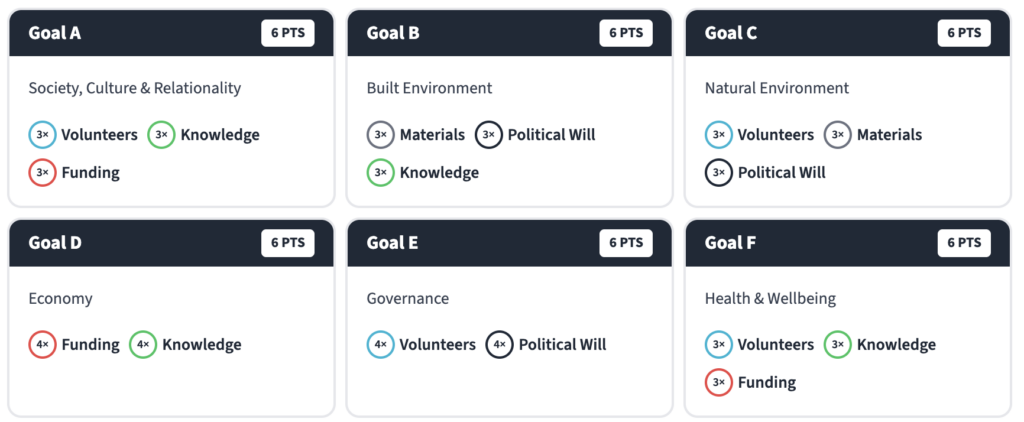
- Community Resilience Goal Cards: 6 goal types (A–F). Each worth 6 points.
- Hazard Cards: 12 total. Six hazards, each with Minor and Major versions.
- Player Mats: 7 total, one for each station/role.
- Community Resilience Goals Worksheet (Hazard Mat): A two-sided printed reference sheet used during the pre-game workshop. Side 1 guides hazard selection, impact identification, and goal creation. Side 2 displays the six goal scoring areas (A–F) used throughout the session.
- Round Update Cards: 12 facilitation cards stacked in a fixed order (not simply shuffled). At the start of each round, the first player flips the top card and reads it aloud. Each card contains a discussion prompt (ASK), a game effect (TAKE ACTION), and a duration.
Pre-Game Workshop
From Local Hazards to Shared Resilience Goals: Pre-game Guide
This guide provides step-by-step instructions for completing the Community Resilience Goals worksheet. Using the worksheet, your group will identify local hazards, unpack associated vulnerabilities and capacities, and define related resilience goals. These decisions set the context for gameplay, determine the overall challenge level, and anchor post-game reflection in your real community context.
Community Resilience Goals Worksheet
Before the game begins, each table receives a printed Community Resilience Goals Worksheet (also called the Hazard Mat). This two-sided reference sheet guides the pre-game workshop and stays on the table throughout the session.
Side 1 walks your group through the four steps below: selecting hazards, identifying local impacts and capacities, defining resilience goals across six value areas, and recording those goals. BC-Disaster and Climate Change Risk Assessment (DCCRA 2025), and the six Resilience Goal Value Areas (A through F) aligned with the DCCRA report.
Side 2 displays the six Community Resilience Goal scoring areas (Goals A through F), each showing the goal’s value area, a space for the short title your group creates, the pre-set resource cost in permanent bonuses, and checkboxes for tracking which completed projects contribute toward achieving each goal. This side is used throughout the game session as players work toward achieving their co-created goals.
STEP 1 — SELECT HAZARDS
Select 1-3 local climate/disaster hazards. The regional hazards and climate projection signals below are meant to support your thinking, not to limit or prescribe it.
- Major hazard = +5 points
- Minor hazard = +2 points
STEP 2 — IDENTIFY IMPACTS, VULNERABILITIES & STRENGTHS
For each hazard, be specific:
- Affected populations
- At-risk buildings/infrastructure
- Economic impacts
- Cultural & ecosystem loss
- Indigenous rights, lands, governance
STEP 3 — DEFINE RESILIENCE GOALS
Using what you’ve identified, write one resilience goal for each value area (six total). If you selected more than one hazard, assign each goal to the hazard it most directly addresses.
The 6 Value Areas:
- Society, Culture & Relationality
- Built Environment
- Natural Environment
- Economy
- Governance
- Health & Wellbeing
Each goal should:
- Reduce identified vulnerabilities – and/or –
- Strengthen existing capacities.
If you selected multiple hazards, decide which hazard each goal primarily relates to.
STEP 4 — RECORD YOUR GOALS ON THE GAME MAT
Create a short title for each resilience goal and write it in the appropriate goal scoring area below. Point values and resource costs are already set.
REGIONAL CLIMATE PROJECTIONS
Along with understanding the local hazards your community/region experiences, it is helpful to know how climate change may affect and influence those hazards by accessing regional climate projections. In BC, you may be able to access up-to-date regional climate projections from your local government or from the Pacific Climate Impacts Consortium (PCIC: https://www.uvic.ca/pcic/research-resources/regional-assessments/index.php).
Below is an example of regional climate projections for the Comox region:
| Hazard | Climate Projection Signals |
|---|---|
| EXTREME HEAT & HEATWAVES | +2.5°C warmer annually by 2050s+3.5°C hotter on the warmest summer days+23 additional days over 25°C; +8 more days over 30° |
| Wildfire & Wildfire Smoke | Hotter, drier summers: −16% summer precipitation by 2050sMore consecutive hot days; earlier snowmelt and lower summer flows |
| Riverine & Urban Flooding | Fall +12% precipitation (2050s)Winter +4% precipitation (2050s)+29% more rain on the heaviest “wet days” by 2050sHigher winter peak flows; reduced snowpack stability |
| Coastal Flooding & Storm Surge | Increased frequency and intensity of coastal storm surge eventsCombined effects of sea level rise + stronger fall/winter storms |
| Drought & Water Scarcity | Summer precipitation: −16% by 2050sLower summer stream flows; earlier snowmeltWarmer temperatures increasing evapotranspiration |
| Storm Events & High Winds | Wetter winters and falls with more saturated soilsStronger storms increasing tree blowdown risk |
| Ecosystem Disruption & Biodiversity Loss | Warmer annual temperaturesLonger growing season (55+ additional days by 2050s)Lower summer flows and higher winter flowsSpecies migration |
RESILIENCE GOAL VALUE AREAS
(aligned with value areas established in DCCRA report)
| Letter | Value Area | Short Description |
|---|---|---|
| A | Society, Culture & Relationality | Connections, identity, culture, networks of care, belonging. |
| B | Built Environment | Housing, energy, transportation, utilities, infrastructure. |
| C | Natural Environment | Ecosystems, water, biodiversity, land, salmon, soils, forests. |
| D | Economy | Livelihoods, businesses, workers/employment, economic stability. |
| E | Governance | Decision-making, policy, funding, collaboration, leadership. |
| F | Health & Wellbeing | Physical, mental, emotional, spiritual health & care systems. |
CROSS-SYSTEM IMPACTS & RESILIENCE GOALS WORKSHEET
Use A-F Value Areas from the table above
| Hazard | Value Area (A-F) | Local vulnerabilities | Relevant local capacities | Resilience Goals (short title/description) |
|---|---|---|---|
| Hazard 1: ___________ | A | ||
| B | |||
| C | |||
| D | |||
| E | |||
| F | |||
| Hazard 2: ___________ | A | ||
| B | |||
| C | |||
| D | |||
| E | |||
| F |
Calculate Target Score from Selected Hazards
Final Target = Base (56) + Minor Hazards (+2 each) + Major Hazards (+5 each)
Example: Base 56 + Major Wildfire (+5) + Major Flood (+5) + Minor Drought (+2) = 68 target
On your first game, try 2 hazards only.
Table Setup
Table Setup
Place the round update cards next to the first player. Nominate a first player. Use a pen to track completed goals on the Hazard Mat.
Assign Roles: Choose 4 of the 7 available stations/roles.
Prepare Resource Tokens: Take 7 of each standard colour and 5 Wild Aid from the box and stack in resource storage area.
Review Station Rules: Each player reviews their player mat. Start on side one.
Starting Resources: Each player takes the starting tokens listed on their mat from the tokens stacked for the game.
Common Supply: Place remaining tokens in a common area within reach of all players.
Setup Project Cards:
Separate Level 1 and Level 2 project cards by level.
For Level 3: Select the hazard decks matching the hazards chosen during the pre-game workshop. Set the remaining Level 3 decks aside; they will not be used this session. Shuffle the 2 selected hazard decks together to form a single Level 3 deck.
Shuffle each level separately to create three independent decks.
Place each shuffled deck face down in its designated area.
From each face-down deck, draw 4 cards and place them face up in a row to form 3 rows of 4 cards.
Layout: Top row = Level 3, Middle row = Level 2, Bottom row = Level 1.
Resource Storage
Project Cards
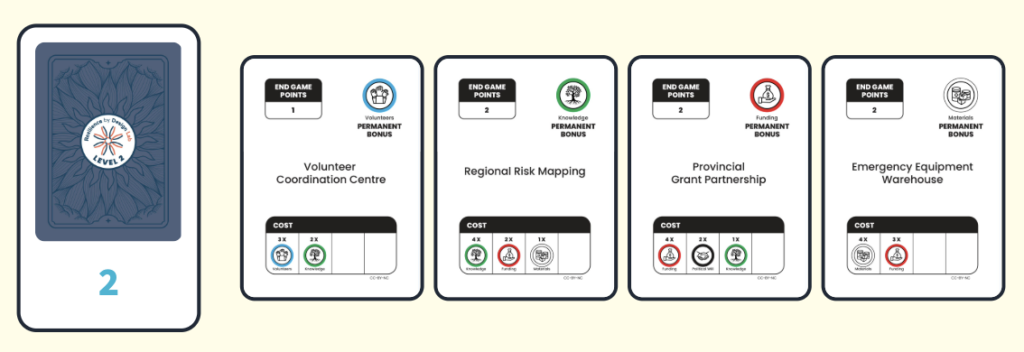
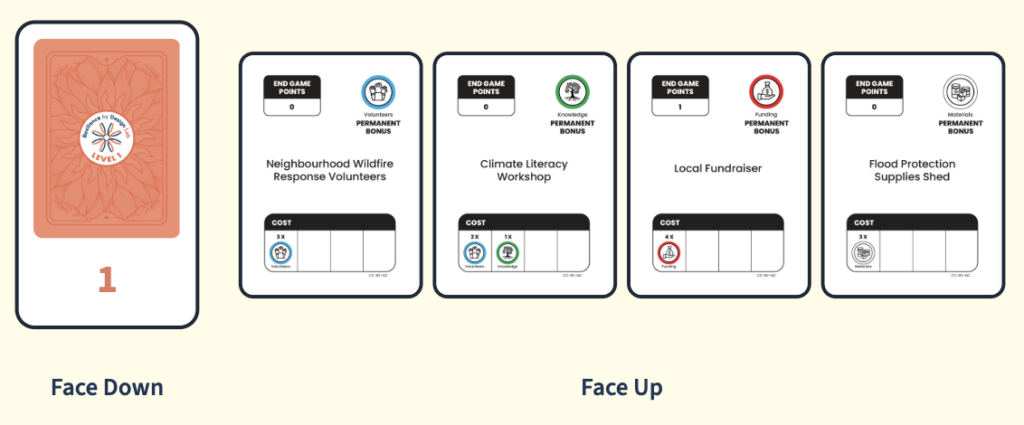
TURn Structure
Start a 1-hour timer. Play proceeds clockwise.
The first player flips the top Round Update Card and reads it aloud. Every round, the first player flips a new card and reads it aloud.
On Your Turn (in order):
Note: Player mats have two sides. Start on Side 1 and flip to Side 2 when the Round Update Cards prompt you to.
- Perform exactly one main action: Take Resources, or Complete a Project.
- Optional: Claim at most one goal using permanent bonuses only.
- End of Turn: Check token limit (max 10), refill project slots (4 for each of Level 1, 2, and 3), next player’s turn in clockwise order.
Side 2 Additional Actions
- Optional: Use your station’s once-per-turn special power.
- Optional: Make one trade offer using your station’s trade power (consent required).
- New main action: Reserve a Project (see Main Actions below).
Important Limits
- Maximum 10 tokens per player at end of turn (including Wild Aid). Discard extras back to supply.
- Projects refill immediately when taken or completed. Refill project slots to 4 for each of Level 1, 2, and 3.
- Keep communicating with your team throughout!
Main Actions
On your turn, choose exactly one of these main actions:
Main Action 1: Take Resources
- Take 3 different tokens from the supply.
- Province role may take 4 different tokens instead of 3.
Main Action 2: Complete a Project
- Pay the cost listed on the project using tokens and/or permanent bonuses.
- Wild Aid tokens can substitute for any resource type.
- Place the completed card face-up in the matching “Completed Projects” area on your mat.
- Gain the project’s printed points.
Main Action 3: Reserve a Project (Side 2 only)
Reserving is the only way to get Wild Aid tokens.
Gain 1 Wild Aid token (if available in the supply).
Take 1 face-up project from any level OR draw 1 blind from any deck.
Place it in your “Reserved Projects” area on your player mat.
Why Reserve?
- Strategic hold: secure a card so no one else can complete it.
- Get Wild Aid: this is the ONLY way to obtain Wild Aid tokens.
- Reveal new cards: when you take a face-up card, it gets replaced from the deck.
Reserve limits: Standard = 3 cards; Local Government / Local Authority = 4 cards.
Understanding Permanent Bonuses
When you complete a project, it gives you a permanent bonus icon matching the card’s colour border. These bonuses have two uses:
- For Projects: Reduce the token cost of future projects. Each bonus icon of a colour reduces that resource cost by 1.
- For Goals: Goals can ONLY be claimed using permanent bonuses. Tokens in hand do not count.
Card Replenishment
After completing or reserving a project from the face-up display, immediately replace it by drawing one card from the same level’s face-down deck. Face-down decks remain hidden at all times and are never reshuffled.
When a Project Deck Runs Out
- If a face-down deck for any level is empty, cards are not replaced for that level.
- The row may contain fewer than four face-up cards.
- This applies independently to each level.
- It is common for Level 1 projects to run out before higher levels.
Player Roles (7 Available)
Choose 4 of 7 available stations to sit at the table. Each station has unique abilities. One or more people may share a station and act as a team.
Understanding Your Player Mat
Each player mat has several important sections:
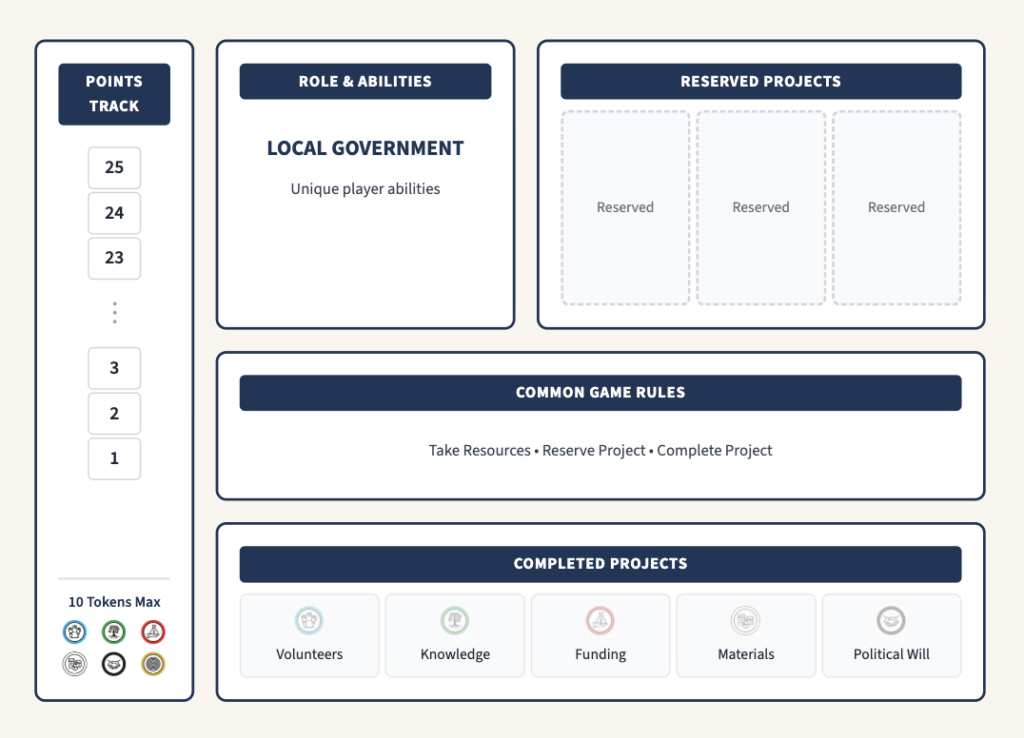
1
Points Track (Left Side)
Track your score from 1-25 as you complete projects. Also shows the 10-token maximum reminder.
2
Role Identity & Abilities (Center Top)
Shows your role name, starting resources, and unique player abilities that apply only to you.
3
Reserved Projects (Top Right)
Place face-up or blind projects here when you reserve them. These are yours alone—no one else can complete them. Limit: 3 cards (or 4 for Local Government/Authority).
4
Common Game Rules (Center Right)
Quick reference for the three main actions: Take Resources, Reserve a Project, and Complete a Project.
5
Completed Projects (Bottom)
Place finished project cards here, organized by resource type. The icons at the bottom track your permanent bonuses—these count toward Community Resilience Goals!
💡 Important: Permanent bonuses (icons on completed projects) are different from tokens in your hand. Only permanent bonuses count toward claiming Community Resilience Goals!
The 7 Player Roles
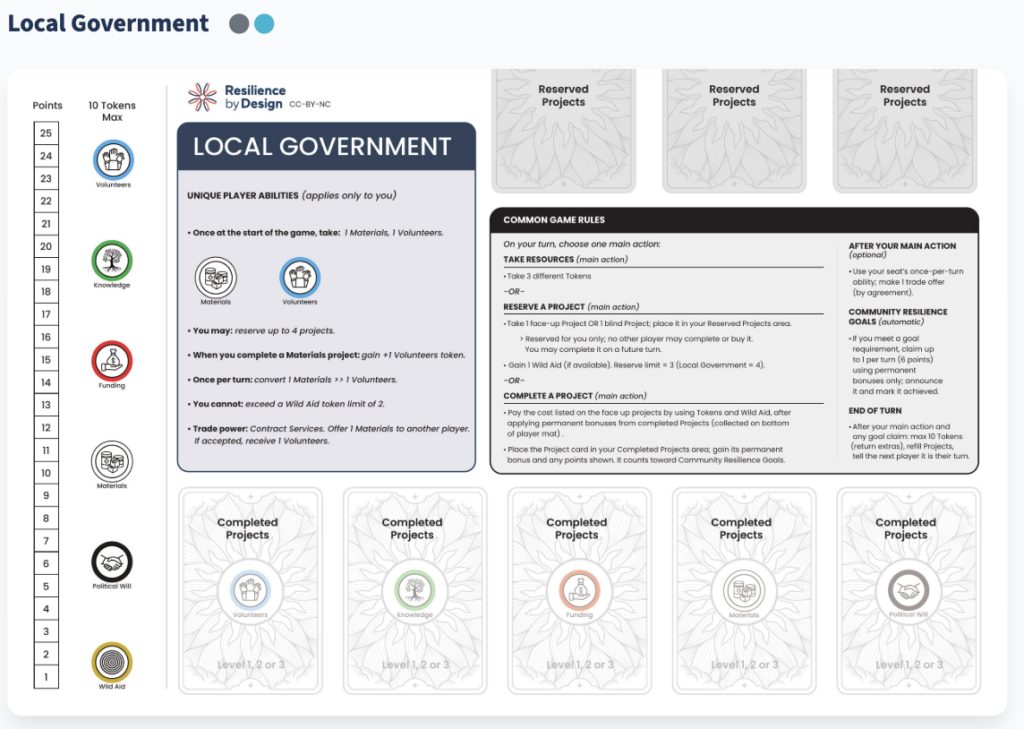
Starting Resources: 1 Materials, 1 Volunteers
- May reserve up to 4 projects (instead of 3)
- When you complete a Materials project: gain +1 Volunteers token
- Once per turn: convert 1 Materials → 1 Volunteers
- Wild Aid cap: 2
Trade Power – Contract Services: Offer 1 Materials to another player. If accepted, receive 1 Volunteers.
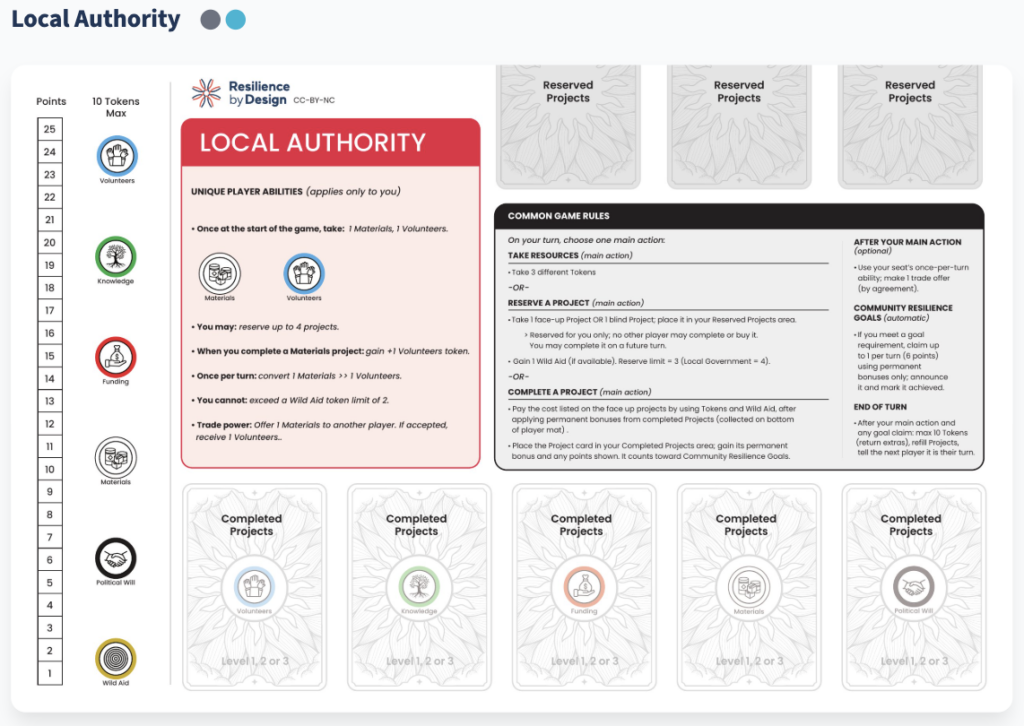
Starting Resources: 1 Materials, 1 Volunteers
- May reserve up to 4 projects (instead of 3)
- When you complete a Materials project: gain +1 Volunteers token
- Once per turn: convert 1 Materials → 1 Volunteers
- Wild Aid cap: 2
Trade Power: Offer 1 Materials to another player. If accepted, receive 1 Volunteers.
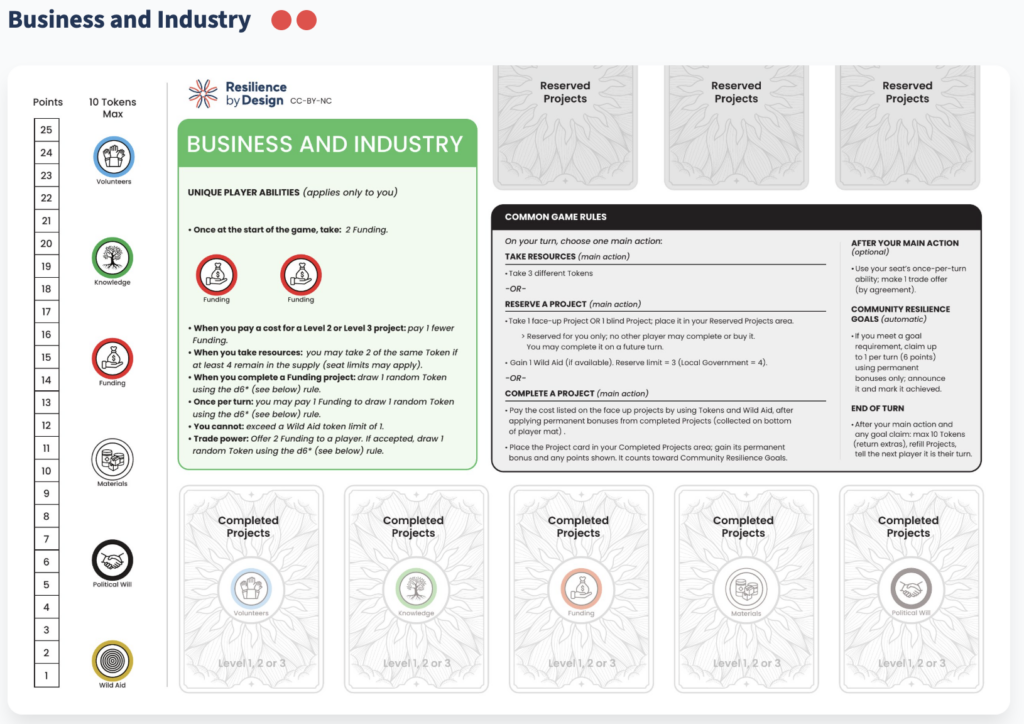
Starting Resources: 2 Funding
- Pay 1 fewer Funding on all Level 2 and Level 3 projects
- When you complete a Funding project: draw 1 random token (d6 rule)
- Once per turn: pay 1 Funding to draw 1 random token (d6 rule)
- Wild Aid cap: 1
Trade Power: Offer 2 Funding to a player. If accepted, draw 1 random token using the d6 dice and rules (see the bottom of the page: “Random Token Rule”).
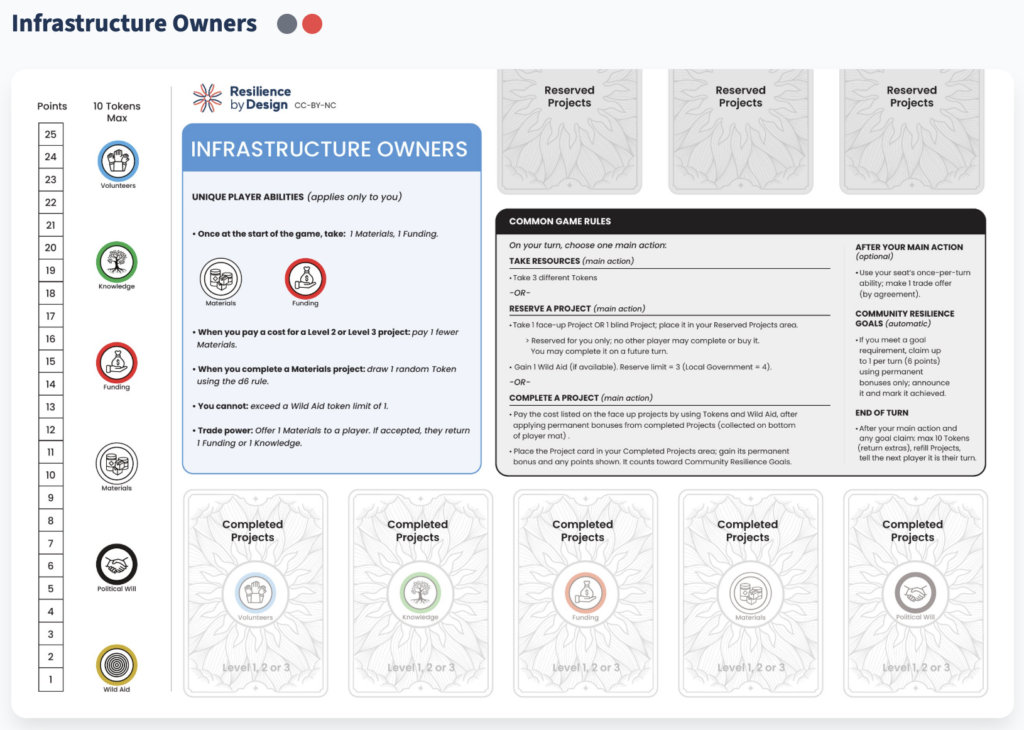
Starting Resources: 1 Materials, 1 Funding
- Pay 1 fewer Materials on Level 2 and Level 3 projects
- When you complete a Materials project: draw 1 random token (d6 rule)
- Wild Aid cap: 1
Trade Power: Offer 1 Materials to a player. If accepted, they return 1 Funding or 1 Knowledge.
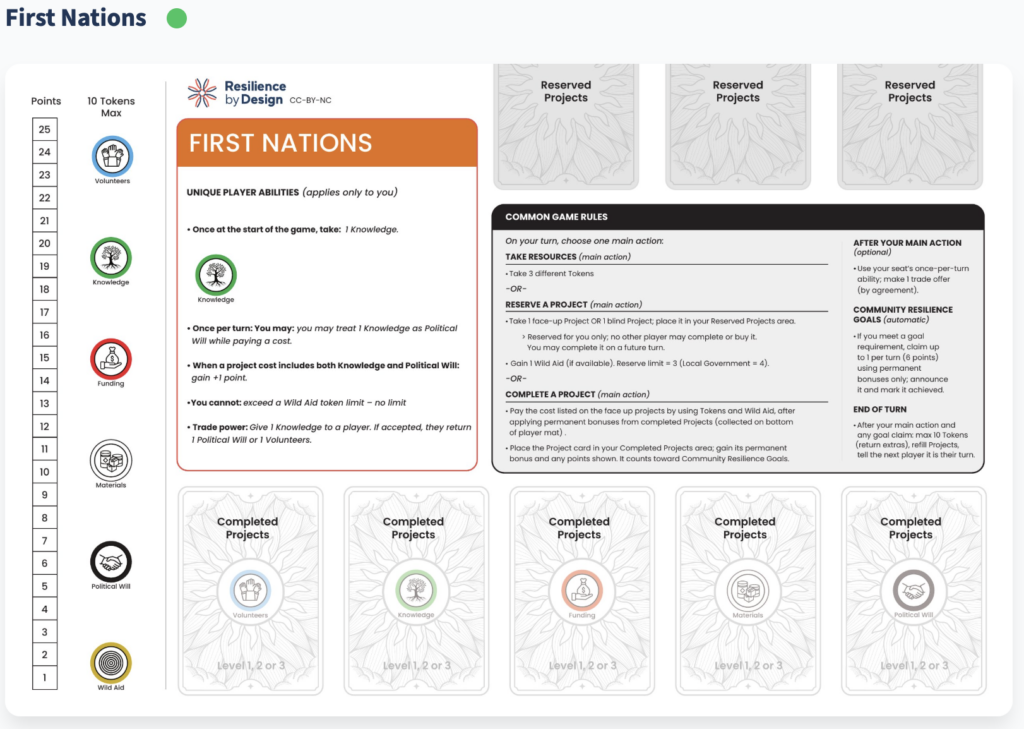
Starting Resources: 1 Knowledge
- Once per turn: treat 1 Knowledge as Political Will while paying project cost
- When a project cost includes both Knowledge and Political Will: gain +1 point
- Wild Aid cap: No limit
Trade Power: Give 1 Knowledge to a player. If accepted, they return 1 Political Will or 1 Volunteers.
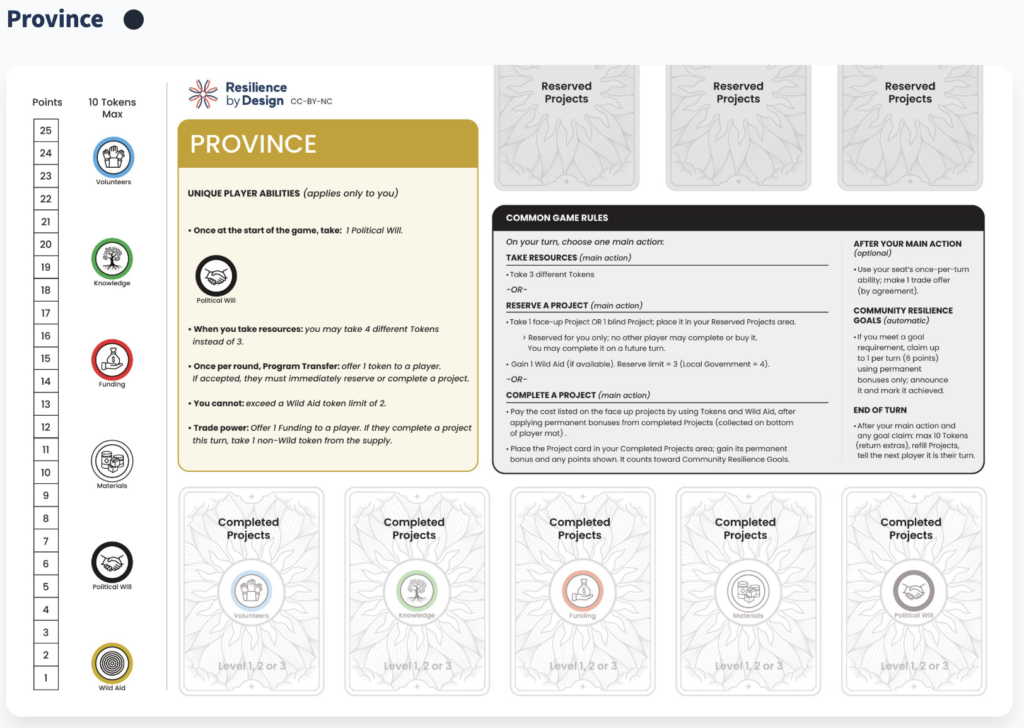
Starting Resources: 1 Political Will
- When taking resources: may take 4 different tokens instead of 3
- Once per round, Program Transfer: Offer 1 token to a player. If accepted, they must immediately reserve or complete a project.
- Wild Aid cap: 2
Trade Power: Offer 1 Funding to a player. If they use that token to complete a project this turn, take 1 non-Wild token from the supply.
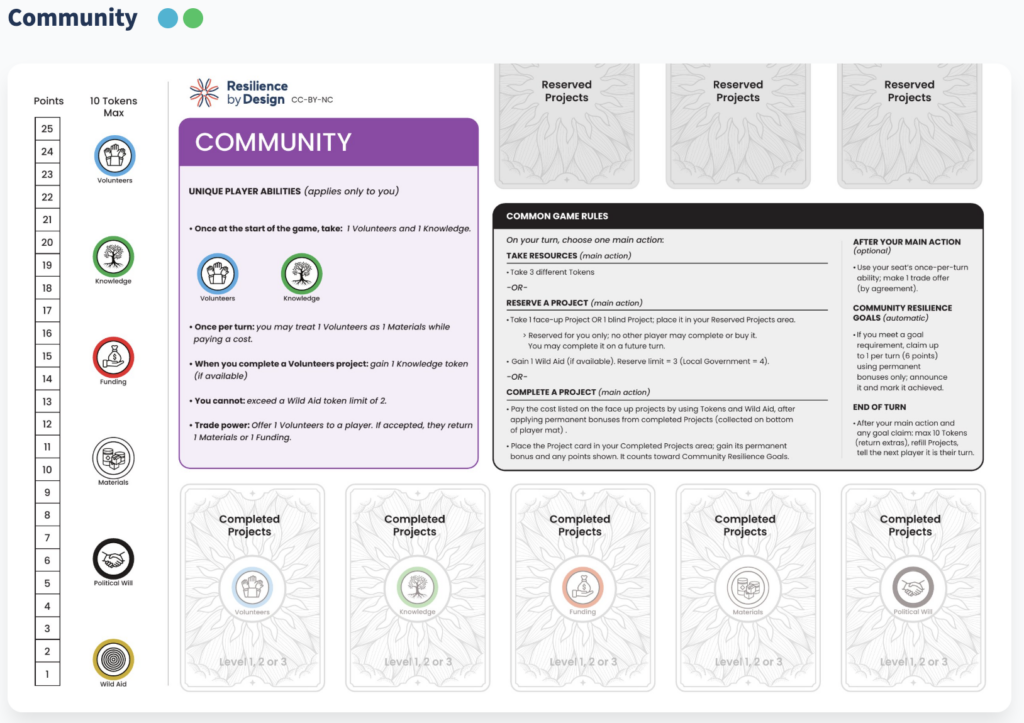
Starting Resources: 1 Volunteers, 1 Knowledge
- Once per turn: treat 1 Volunteers as 1 Materials while paying a cost
- When you complete a Volunteers project: gain 1 Knowledge token (if available)
- Wild Aid cap: 2
Trade Power: Offer 1 Volunteers to a player. If accepted, they return 1 Materials or 1 Funding to resource storage.
Community Resilience Goals
Key Rules for Goals
- Each goal is worth 6 points
- Goals are claimed using permanent bonuses ONLY (from completed projects)
- Tokens in hand do NOT count toward goal requirements
- You may claim at most 1 goal per turn
How to Achieve Goals
Goals are achieved by completing project cards on your player mat. Here’s how it works:
Important Restrictions
- Each player must have the required projects completed on their own player mat
- Projects may NOT be traded, shared, or pooled to achieve a goal
- Only the projects on an individual player’s mat may be used to meet a goal’s requirements
- Tokens may NOT be used to achieve goals; only completed projects and their permanent bonuses count
To achieve a goal: Count the permanent bonuses (resource icons) on your completed project cards. If you have enough of the required types, you may claim that goal on your turn and immediately add 6 points to your score.
The 6 Goal Types
Trading Rules
Once per turn, the active player may make one trade offer using their station’s Trade Power
Consent is required – the receiving player may decline with no penalty
Trades move tokens only (not project cards or goals)
Respect any Wild Aid caps
No chain trades in the same turn
Round Update Cards
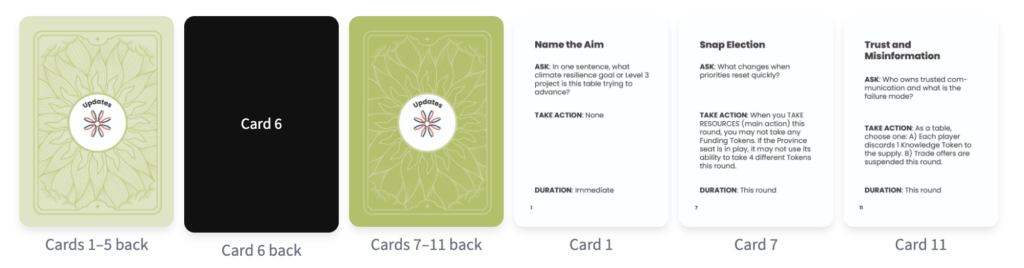
Round Update Cards are a deck of 12 facilitation cards that introduce real-world pressures, reflective pauses, and gameplay effects into the session. One card is flipped at the start of each round. The deck is not simply shuffled: it is stacked in a deliberate order to ensure Card 6 arrives at the structural midpoint and Card 12 anchors the end of the session.
Important Restrictions
- Each player must have the required projects completed on their own player mat
- Projects may NOT be traded, shared, or pooled to achieve a goal
- Only the projects on an individual player’s mat may be used to meet a goal’s requirements
- Tokens may NOT be used to achieve goals; only completed projects and their permanent bonuses count
Card Structure
Each Round Update Card has three elements:
- ASK: A discussion prompt read aloud to the table. Players briefly discuss before continuing play.
- TAKE ACTION: A game effect that applies to all players. Some cards have no action (“None”), while others impose constraints or create opportunities.
- DURATION: “Immediate” (resolved once), “This Round” (effect expires at end of the current round), “Permanent” (applies for the rest of the game), or “Rest of Game” (continues through any extension period).
The 12 Round Update Cards
| # | Title | ASK | TAKE ACTION | Duration |
|---|---|---|---|---|
| 1 | Name the Aim | In one sentence, what climate resilience goal or Level 3 project is this table trying to advance? | None | Immediate |
| 2 | Define the Context | Name 1 to 2 hazards you are planning for and one shared vulnerability across them. | None | Immediate |
| 3 | Pick the First Move | Name one Level 1 or Level 2 Project you expect will help you reach that goal. | None | Immediate |
| 4 | Mutual Support | What kind of support is easiest to share early? | Each player may give 1 Token of their choice to the player on their left. This is a gift, not a trade. Optional. | Immediate |
| 5 | Coordination Check | What do you need from the table to make that intention realistic? | In clockwise order, each player states one intention for the next round: complete a Level 1 Project, complete a Level 2 Project, or set up for Level 3. | Immediate |
| 6 | Start of Second Half of Fiscal Year | Read your special abilities aloud to the table. | Flip all player mats to Side 2. Reveal special abilities. Add Wild Aid Tokens to the supply. RESERVE A PROJECT and trade offers are now available. | Permanent |
| 7 | Snap Election | What changes when priorities reset quickly? | When you TAKE RESOURCES (main action) this round, you may not take any Funding Tokens. If the Province seat is in play, it may not use its ability to take 4 different Tokens this round. | This round |
| 8 | Approval Gate | What real approval or governance step does this represent? | The first time each player completes a Project this round, that completion costs plus 1 Political Will Token. If unable, discard 1 non-Wild Token instead. | This round |
| 9 | Procurement Delay | Where do procurement timelines disrupt implementation in your setting? | When you RESERVE A PROJECT (main action) this round, do not gain a Wild Aid Token from reserving. | This round |
| 10 | Staff Shortage | What work continues and what work stops when capacity is thin? | The first time you TAKE RESOURCES (main action) this round, take 1 fewer Token than normal (minimum 1). | This round |
| 11 | Trust and Misinformation | Who owns trusted communication and what is the failure mode? | As a table, choose one: A) Each player discards 1 Knowledge Token to the supply. B) Trade offers are suspended this round. | This round |
| 12 | Extension Granted | What would you change if you had more time? | Continue play for the agreed extension period using all current rules and constraints. | Rest of game |
Stacking the Deck
The deck is not fully shuffled. It is assembled in a fixed order before play begins:
- Place Card 12 (Extension Granted) face down. This is the bottom of the deck. Do not shuffle it.
- Shuffle Cards 7 to 11 and place them face down on top of Card 12.
- Place Card 6 (Start of Second Half of Fiscal Year) face down on top of Cards 7 to 11. Do not shuffle Card 6.
- Shuffle Cards 1 to 5 and place them face down on top of Card 6.
Final deck order from top to bottom: Cards 1–5 (shuffled) / Card 6 (fixed) / Cards 7–11 (shuffled) / Card 12 (fixed).
During Play
- Place the stacked deck face down next to the first player before the game begins.
- At the start of each round, the first player flips the top card and reads the ASK aloud. Allow a brief discussion (30–60 seconds) before applying the TAKE ACTION effect.
- “This Round” effects expire at the end of the current round of turns.
- When Card 6 is flipped, all players immediately flip their player mats to Side 2 before taking their turns. This is a permanent change.
- Card 12 is only reached if the group opts for an extension. If no extension is taken, it remains unflipped.
End of Game & Scoring
When the Timer Expires
The game ends when the 1-hour timer expires. This represents the end of the fiscal year.
Calculate Final Score
- Total all project points from completed projects (all players)
- Add points for all achieved community resilience goals
- Compare total to your target score
Win or Lose
- Meet or exceed target: The community wins together! 🎉
- Below target: The community loses together, but gains valuable insights.
Optional 15-Minute Extension
After scoring and a short discussion, the group may decide to add 15 more minutes of play. Continue from where you left off, then rescore and discuss what changed.
Random Token Rule (d6)
Some abilities let you draw a random token. Roll a 6-sided die:
| Die Roll | Token |
|---|---|
| 1 | Volunteers |
| 2 |  Knowledge |
| 3 |  Funding |
| 4 |  Materials |
| 5 | 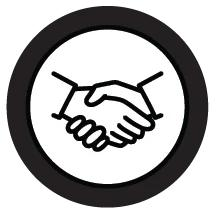 Political Will |
| 6 | 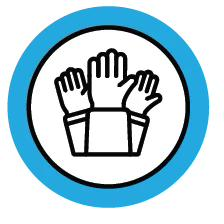 Volunteers |
How It All Fits Together
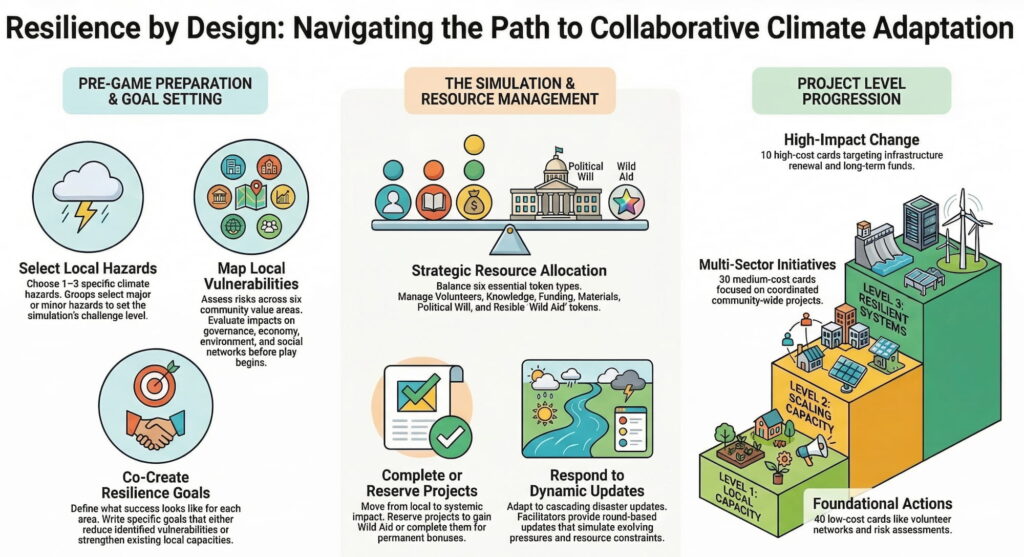
A visual overview of the full Resilience by Design game structure, from pre-game preparation through project level progression.
You can review all the components of the game above.
Or you can begin by reading the guidebook.
When you are ready to play, you can download all components here.
All components are licensed under a CC BY 4.0 licence.