Climate Preparedness
Duration: 2025-2026
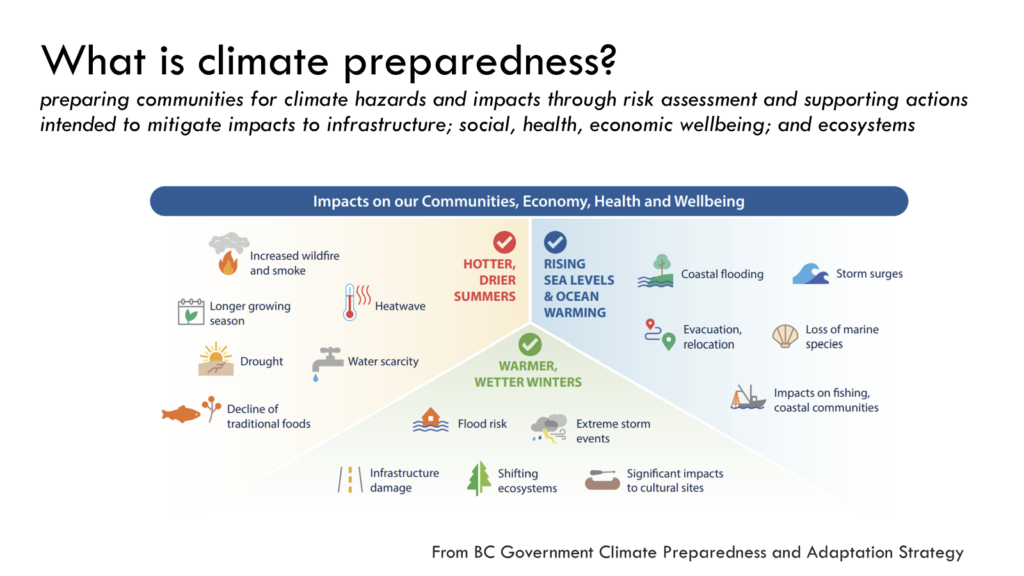
This project is focused on developing knowhow in support of BC’s Climate Preparedness and Adaptation Strategy and how BC is preparing for climate disasters. As such, the project team informally refers to this work as the “climate preparedness” project.
The project has been undertaken through financial support from the Province of BC (Ministry of Energy and Climate Solutions, previously Ministry of Environment and Climate Change Strategy), in collaboration with Climate Risk Institute (CRI). At the national level, guidance for climate preparedness knowhow has been established through Canada’s National Adaptation Strategy (NAS); while Public Safety Canada is the leading department for the “disaster resilience” system within the National Adaptation Strategy.
This Climate Preparedness Project….
- tests immersive, participatory learning as a capacity-building approach for fostering climate resilience knowhow in local governments.
- offers a workshop and gameplay experience to local government participants who live and work in a defined region, envisioning and preparing for climate impacts, risks and vulnerabilities, together.
The project goal is to contribute to climate preparedness capacity-building through a participatory workshop/tabletop experience which applies various social learning theories:
- localized methods are essential in enabling diverse networks of individuals and organizations to imagine and prepare for climate futures, in their region, together.
- climate preparedness, and climate action in general, demands new ways of thinking and doing to ensure that decision-making, policy design, and agenda-setting can meet emerging needs for risk management, sustainability, equity, and resilience.
- building collaborative processes through engagement in an immersive social learning approach, helps in envisioning plausible futures; envisioning is critical for implementing climate adaptation measures, emergency management practices, and climate preparedness governance;
- “serious games” are a useful approach for engaging communities in envisioning; and can be facilitated in digital, analog or hybrid modes. Learn more about climate games (see PowerPoint presentation or download PDF version)
Why Serious Games?
Localized social learning through immersive gameplay…
- enables participants to share and explore diverse knowledge and responsibilities, and risk and resilience options, through envisioning local climate impact scenarios in a safe, equity-supported experience;
- is centered on local community priorities;
- lifts local voices;
- drives co-operative climate action by fostering collaboration, systems thinking, trust, relationship-building, and scenario envisioning.
- draws on theory and practice within participatory scenario planning for emergency preparedness. (Galang et al., 2025)
Gameplay is often used in education, policy engagement, community planning and emergency management to turn abstract or complex climate and emergency challenges into tangible experiences.
Dr. Robin Cox, RbD Lab Director explains more theory and practice in Why Serious Games? (PDF).
Who Is This For?
The climate preparedness workshop and gameplay approach developed through this initiative is designed for use by rural and remote local governments, municipalities, regional districts, and Indigenous communities. Face-to-face workshops incorporating localized scenarios, help to practice responses to community-specific climate change impacts and hazards, and related vulnerabilities.
Key Events
- Evaluation of The Adaptation Game (June 2025) (see PDF)
- Evaluation of Design-a-Disaster (July 2025) (see photos)
- Victoria Forum 2025 presentation (Aug 24–26, UVic) (see PowerPoint presentation or download PDF version)
- Resilience workshop (prototype #1): Nelson, BC (Oct 2025) (see photos)
- Resilience workshop (prototype #2): Comox, BC (Jan 2026) (photos coming soon)
Project Methodology
RbD Lab has undertaken a “discovery-design-develop-prototype-recommend” process and incorporated monthly progress reports and integration of project sponsor feedback into the 12-month timeline of this initiative.
Discovery
- authored a “Synthesis Report” on the current state of climate preparedness capacity-building in B.C. as a basis for undertaking further actions on his initiative. This report included an extensive review of peer-reviewed literature, grey literature reports, and emergent work on the B.C. Disaster and Climate Risk and Resilience Assessment (DCRRA), with a focus on climate risk assessment and capacity-building advances and gaps;
- explored various commercial and community “product options” for facilitating an immersive, participatory learning experience;
- undertook a deeper evaluation of 2 distinct localized workshop/tabletop experiences – at the intersection of climate impact topics and participatory learning by observation and participation in:
- The Adaptation Game, developed by a team in Australia and convened for the first time in Canada through Amy Spark and Geoff Evamy Hill at Bow Valley College in Calgary, Alberta (June 2025);
- Design-a-Disaster experience, conceived and hosted by Tarina Colledge, Manager of Emergency Management, at Fraser Valley Regional District (July 2025).
Design
- Decision to “custom design/develop” an immersive workshop incorporating gameplay specific to BC local government contexts, drawn from learnings in both the Synthesis Report and the observations of other workshops; articulated the “design principles” and initiated design
Design Principles
informed by (1) Synthesis Report and (2) Observation/Participation in two games
- Cost-effective localization, with map-and-climate-data information (climate impacts are very localized);
- “Participation prompts” presented at appropriate professional level for collaborative scenario work;
- Mix of participants to bring diverse professional experience in natural resource management, ecological issues, watershed management, social resilience, critical infrastructure management, risk evaluation, emergency management;
- Participants have some familiarity with the issues of multiple levels of governance;
- Relevant for local government and emergency operations centre employees, policy analysts, city councillors, critical infrastructure providers, etc.;
- Can be extended for other professional development and post-secondary learning situations;
- Integrates critical thinking, problem-solving and working together competencies (e.g. Climate Action Competency Framework);
- Applies facilitation methods to bring people together in an immersive cohort experience, where they build relationships, trust, knowhow, and climate preparedness.
Develop
- initiated development and user experience testing of the “Resilience Workshop” with the help of tabletop game expert, Dr. Brooks Hogya.
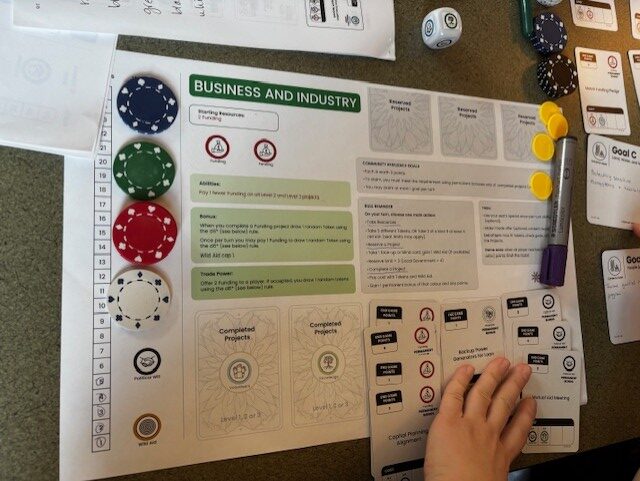
- contracted a visual designer to create artefacts (tabletop board, cards, etc.)
- applied the Working Together domain (Climate Action Competency Framework) to the design and development of the Resilience Workshop outcomes.
Prototype
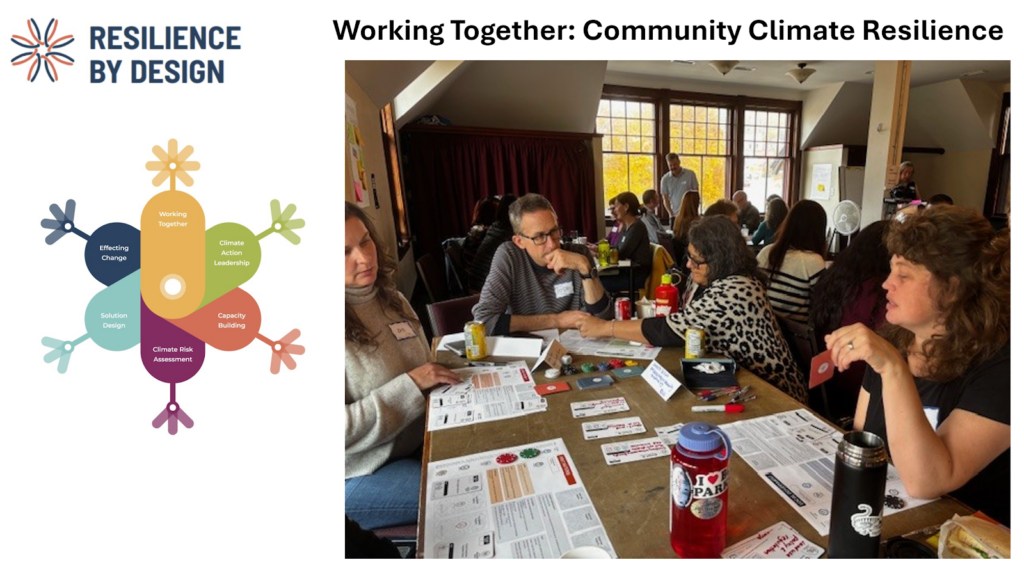
- Convened two separate Resilience Workshop events in rural and remote communities (e.g., Regional District Central Kootenay, and Comox Valley Regional District). The invited participants (about 20 people at each location) are working professionals who serve local and regional government, with portfolios in climate adaptation, infrastructure risk, watershed, wildfire, ecology, emergency management and disaster recovery.
- Evaluated participant feedback, and the effectiveness of this example of participatory scenario learning as a useful contributor to climate preparedness capacity-building.
Recommendation
- Based on prototyping results, communicate outcomes and present a model for ongoing support and scaling-up of the Resilience Workshop.
Our Background
This project builds on 20+ years of experience from Royal Roads University’s Resilience by Design (RbD) Lab. Expertise includes design, development and operations of both academic programming and professional short courses and micro-credentials, in the domains of
- disaster and emergency management,
- climate adaptation leadership.
RbD Lab’s applied research projects are focused on climate action capacity-building, through
- climate literacy initiatives for youth, and
- competency-based leadership development for working professionals (e.g., workforce development).
RbD Lab’s open access Climate Action Competency Framework (CACF), aids in designing learning outcomes and closing competency gaps in climate-focused learning initiatives.
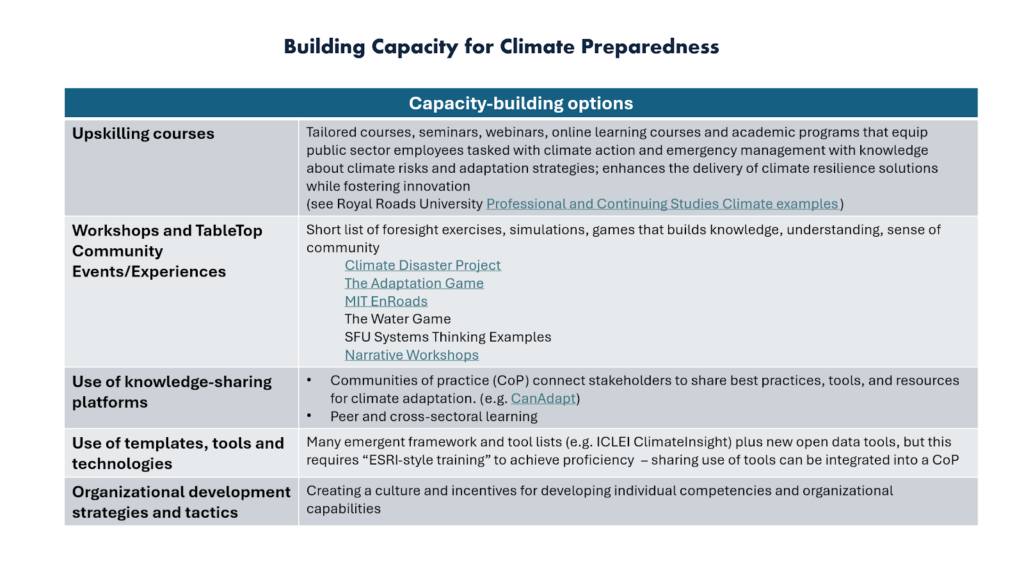
This chart illustrates various capacity-building approaches that were considered for this Climate Preparedness project.