
Universities, colleges and other educational organizations have a critical role to play in accelerating our national capacity to meet the escalating challenges of the climate crises. The National Adaptation Strategy provides a roadmap to a more climate-prepared and climate-resilient Canada, and post-secondary institutions have a responsibility to ensure that students are prepared for the realities of our heating world. While the integration of climate change adaptation knowledge and skills into professional degree programs is underway in Canada, it requires more consistent and fulsome support according to the recently released National Survey report The Status of Climate Change Education. The report, based on a study conducted by the University of Waterloo’s Climate Institute, details both progress and challenges in integrating CCE into key professions such as accounting, engineering, planning and architecture.
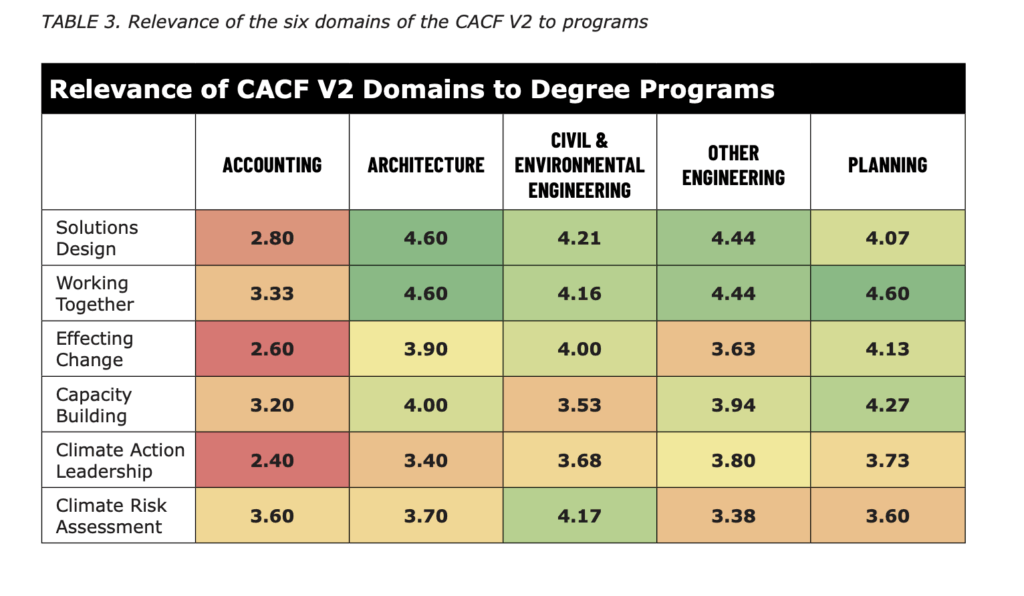
The survey explored the current status of CCE in professional degree programs in Canada, identifying barriers and opportunities and what supports are needed to accelerate this integration of CCE into professional programs. Drawing on the Canadian Climate Action Competency Framework developed by the Resilience by Design Lab, the survey provides a snapshot of what climate action competency domains are deemed to be most relevant to professions, and provides a “strong basis for the using the CACF to support the integration of climate competencies into courses required for students’ graduation and eventual professional accreditation” (p.17).
You can download and read the full report at: https://uwaterloo.ca/climate-institute/sites/default/files/uploads/documents/wci-national-report-final_compressed.pdf